
Is SEO Worth It for Remodelers or Another Expense That Doesn’t Turn Into Jobs?
If You’ve Paid for Marketing Before, This Probably Feels Familiar
If you’re asking “is SEO worth it?” , it’s probably not a casual question.
It usually comes after you’ve already spent money.
Maybe you hired an SEO agency. Maybe you ran Google Ads. Maybe you tried a mix of digital marketing, some paid advertising, some organic search, maybe even a few experiments with social media ads.
And on paper, it looked like things were improving.
You saw reports showing:
- More organic traffic
- Better search rankings
- Increased visibility in search results
- More impressions across search engines
But when you look at your actual jobs?
There’s a gap.

You can’t clearly say:
- “This kitchen remodel came from SEO.”
- “That bathroom project came from our website.”
- “This lead turned into real revenue.”
Instead, it feels like this:
“We’re spending money… but I can’t tie it to actual jobs.”
And when you’re running a remodeling business—managing crews, meeting homeowners, juggling timelines—you don’t have time to analyze search queries or sit through monthly marketing reports.
You just want to know:
Is SEO actually worth it for small businesses like mine—or is this just another expense?
That’s what we’re going to answer here.
No theory. No fluff. Just what actually works when it comes to turning online visibility into real remodeling jobs.
Why SEO Feels Like Just Another Expense for Most Remodelers
Agencies Talk Rankings, Not Jobs
Most remodelers don’t start out skeptical of SEO.
They become skeptical after working with SEO companies.
Because the conversation usually sounds like this:
- “Your search engine optimization is improving.”
- “Your search rankings are going up.”
- “We’re getting more organic traffic.”
- “Your site’s SEO is trending in the right direction.”
And again—none of that is technically wrong.
But it’s not what you actually care about.
You’re not running your business based on:
- Search engine algorithms
- Keyword research reports
- Search volume trends
You’re running it based on:
- Booked jobs
- Project value
- Consistent pipeline
That’s where the disconnect happens.
Most SEO services report on visibility—but don’t connect that visibility to revenue.
So naturally, you start asking:
Is it worth paying for SEO services if I can’t see what it’s actually producing?
Because if SEO work doesn’t lead to qualified traffic and real potential clients, it doesn’t matter how good the reports look.
Lead Platforms Turn Into Price Shopping
A lot of remodeling companies try to solve this by using lead platforms like Angi or HomeAdvisor.
And yes—these platforms can generate leads quickly.
But there’s a tradeoff.
Those leads aren’t exclusive.
They’re shared across multiple contractors.
Which means the homeowner isn’t choosing you—they’re comparing you.
You end up in conversations where:
- Price becomes the main decision factor
- You’re competing against 3–4 other contractors
- The focus shifts away from quality and experience
That’s not a strong position to be in.
It turns what should be a high-trust, high-value service into a bidding war.
Over time, this affects:
- Your margins
- Your time
- The quality of projects you take on
PPC Can Spend Fast Without Clear ROI
Paid ads—especially Google Ads—can absolutely bring in leads.
But they come with pressure.
Clicks in the remodeling space are expensive.
And not every click turns into a serious inquiry.
Without proper tracking, it’s easy to:
- Spend heavily on paid ads
- See some traffic come in
- But still not know which leads turned into real jobs
That creates uncertainty around your marketing dollars.
And when customer acquisition costs keep rising, it gets harder to justify increasing your ad budget.
You’re left in a constant loop:
- Spend more to try to get more leads
- Or pull back because the ROI isn’t clear
Referrals Are Great — But You Can’t Scale Them
Referrals are still one of the best sources of remodeling work.
They bring in:
- High-trust potential customers
- Better close rates
- Less price shopping
But they’re unpredictable.
You can’t control:
- When they happen
- How many come in
- Whether next month will be busy or slow
Most businesses rely on referrals at some level.
But they don’t create a steady stream of work on their own.
The Real Problem: No System, Just Separate Tactics
When you look at everything together, the issue becomes clear.
It’s not that SEO doesn’t work.
It’s not that paid ads don’t work.
It’s not that referrals or platforms don’t work.
It’s that they’re not part of a system.
They’re disconnected efforts.
And that’s why results feel inconsistent.
One month, you’re busy.
The next month, things slow down.
There’s no predictability.
No control.
Just a mix of tactics that sometimes bring in potential clients—and sometimes don’t.
That’s why many businesses start to question:
Is SEO actually worth it—or just another line item in an already confusing marketing plan?
Where Remodeling Leads Actually Come From Today
Google Search and Maps Are the New “Showroom Floor”
The way homeowners find remodelers has changed.
They’re not relying only on referrals anymore.
They’re not flipping through directories.
They’re going straight to search engines.
They’re typing in things like:
- “kitchen remodeler near me”
- “bathroom renovation contractor [city]”
- “home remodeling company near me”
These are high-intent search queries.
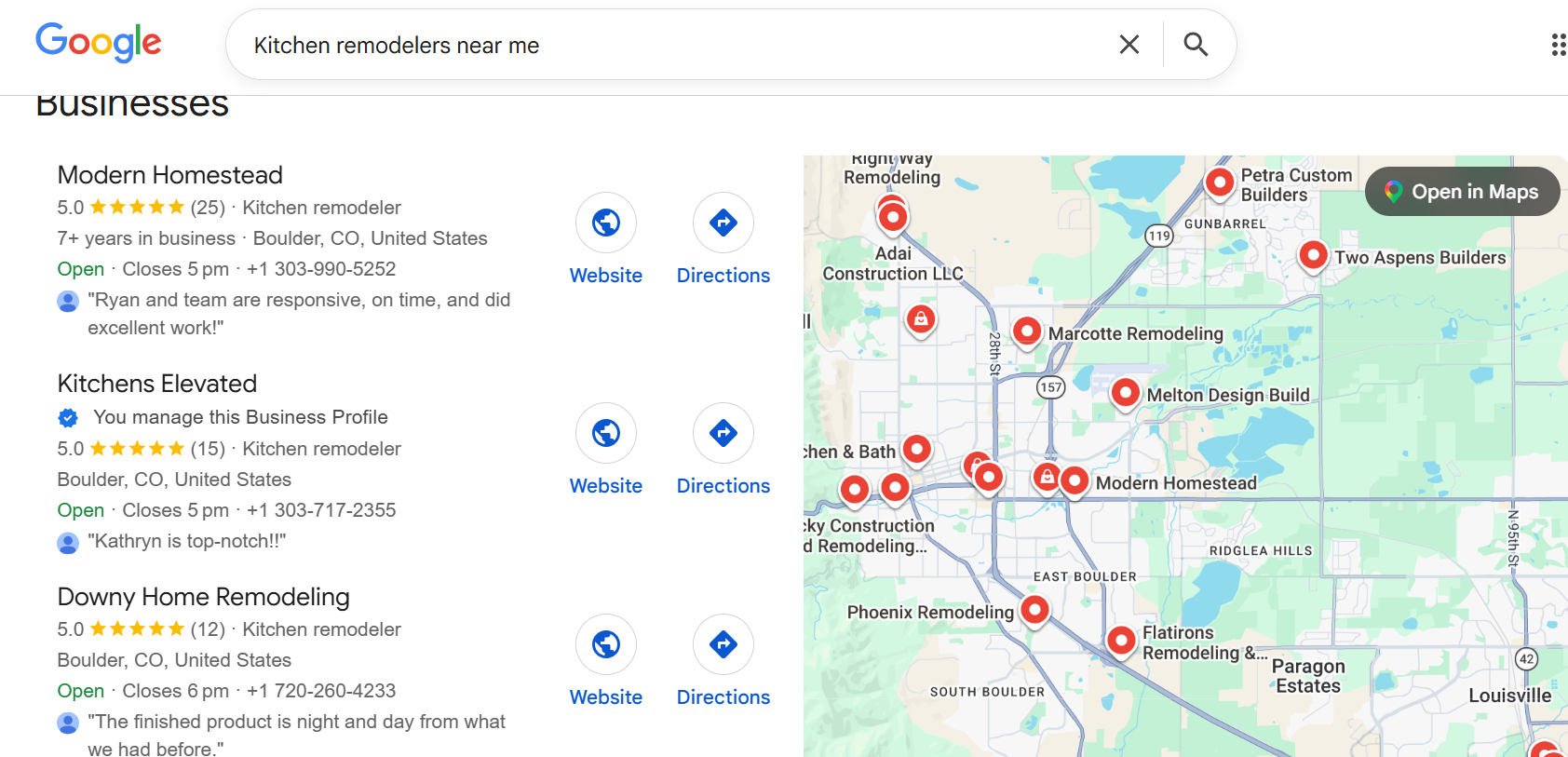
These aren’t casual searches. These are potential customers actively looking for someone to hire.
And this is where search engine optimization actually matters.
Because if your business shows up in those search results—especially in Google Maps—you’re in front of people ready to take action.
That’s what makes SEO worth it when it’s done right.
It puts you in front of qualified traffic at the exact moment they’re searching.
Why Reviews and Proof Matter More Than Ads
Getting visibility is only part of the equation.
What happens after someone finds you is what determines whether you get the call.
In remodeling, homeowners are making big decisions.
They’re not choosing based on the first name they see.
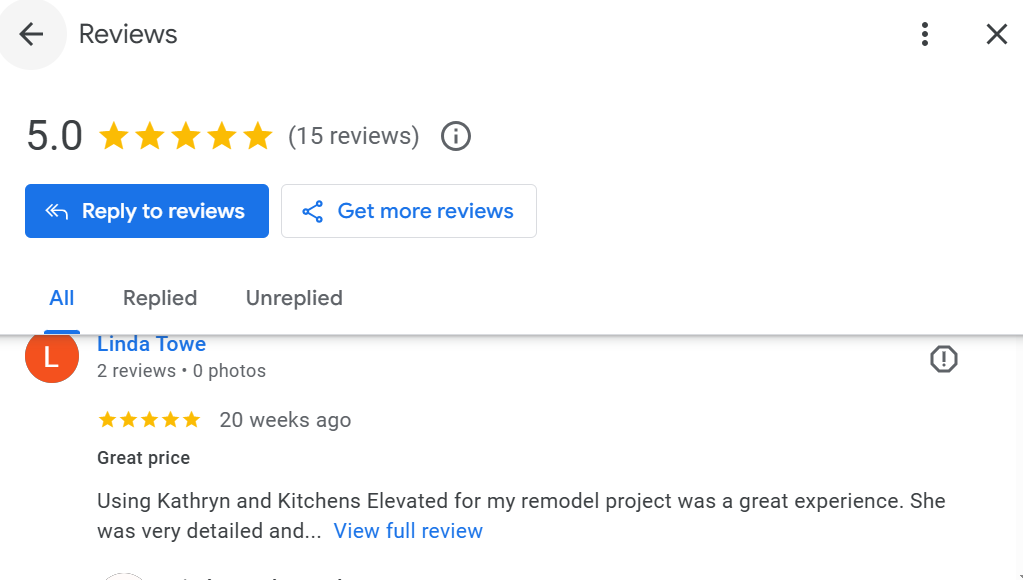
They’re looking for proof.
They look at:
- Your reviews
- Your project photos
- Your website
- How clearly you explain your services
This is where strong SEO strategies go beyond just ranking.
They help you build trust.
Because when someone finds you through organic search results and sees strong proof, they’re more likely to:
- Stay on your site
- Reach out
- Move forward with a conversation
That’s the difference between visibility and conversion.
This Is What SEO Is Actually Supposed to Do
There’s a lot of confusion around SEO.
Many businesses think it’s about:
- Creating content just to create content
- Ranking for high search volume keywords
- Chasing traffic from other search engines
But effective SEO looks different.
It focuses on:
- Matching your business with real user intent
- Showing up for specific keywords that bring in real potential clients
- Driving qualified traffic—not just more traffic
When SEO work is aligned with how people actually search, it becomes a worthy investment.
Because now it’s not just increasing organic traffic—it’s increasing the chances of real conversations.
That’s when you can honestly say:
SEO is worth it.
How SEO Turns Visibility Into Real Remodeling Jobs
Step-by-Step: What Happens When It Works
Let’s walk through what actually happens when SEO is working the way it should.
A homeowner searches:
“bathroom remodel near me”
Your business appears in the search results.
They click.
They check your reviews.
They look at your photos.
They get a feel for your work.
Then they visit your website.
If your site is built properly—with clear services, strong content, and easy navigation—they take the next step.
They call.
Or they fill out a form.
That’s how organic search turns into real leads.
And that’s how SEO work connects to actual business outcomes.
Why Some Contractors Get Calls and Others Don’t
Two remodeling companies can show up in the same search results.
But only one gets the call.
The difference isn’t just search rankings.
It’s everything around them.
- One has 80+ strong reviews, the other has 12
- One shows real project photos, the other doesn’t
- One clearly explains services, the other is vague
These are conversion factors—not just ranking factors.
And this is where many SEO service providers fall short.
They focus on getting you visible—but not on helping you convert that visibility into potential customers.
From Slow Months to Predictable Calls
This is where things start to change for remodelers who get this right.
Instead of relying on:
- Referrals that come and go
- Lead platforms that create competition
- Paid ads that fluctuate
They start building consistency.
Not overnight.
But steadily.
They begin to see:
- A steady stream of inbound calls
- More qualified traffic
- Better project conversations
Because their online visibility is working for them consistently.
Data Point: Why Organic Leads Close Higher
There’s a reason organic search leads tend to perform better.
When someone finds you through organic search:
- They searched for your service intentionally
- They chose your business from the search results
- They reviewed your information before reaching out
That creates a different type of lead.
Compared to shared leads:
- They’re less focused on price
- They’re more focused on fit
- They’re more likely to move forward
This often results in:
- Higher close rates
- Better project quality
- Lower customer acquisition costs
At this point, the question shifts.
It’s no longer just:
“Is SEO actually worth it?”
It becomes:
Why does SEO work for some remodelers—and feel like a waste for others?
Because the difference isn’t SEO itself.
It’s how it’s used.
SEO by itself isn’t a solution.
It only works when it’s part of a system designed to turn visibility into consistent, trackable jobs.
And that’s where most businesses get it wrong.
In the next section, we’ll break down exactly what that system looks like—and how to make SEO worth paying for in a way that actually produces predictable remodeling work.
The 6-Step System That Makes SEO Actually Worth It
This is where the question “is SEO worth it for small business?” gets a clearer answer.
SEO is worth it when it is part of a system.
Not a random blog post.
Not keyword stuffing.
Not a monthly report full of traffic numbers.
Not black hat SEO that tries to trick search engine algorithms.
A real system connects visibility to calls, calls to booked jobs, and booked jobs to ROI.
For remodelers, that system usually has six parts.
1. Optimize Your Google Business Profile
Your Google Business Profile is often the first thing homeowners see before they ever visit your website.
For a remodeler, it should clearly show:
- Kitchen remodeling services
- Bathroom remodeling services
- Whole-home renovation work
- Before-and-after project photos
- Service areas
- Recent reviews
- Accurate phone number and website link
This is one of the fastest things local businesses can improve.
You do not need an in house SEO specialist to clean up basic information, add real project photos, and make sure your categories are accurate.
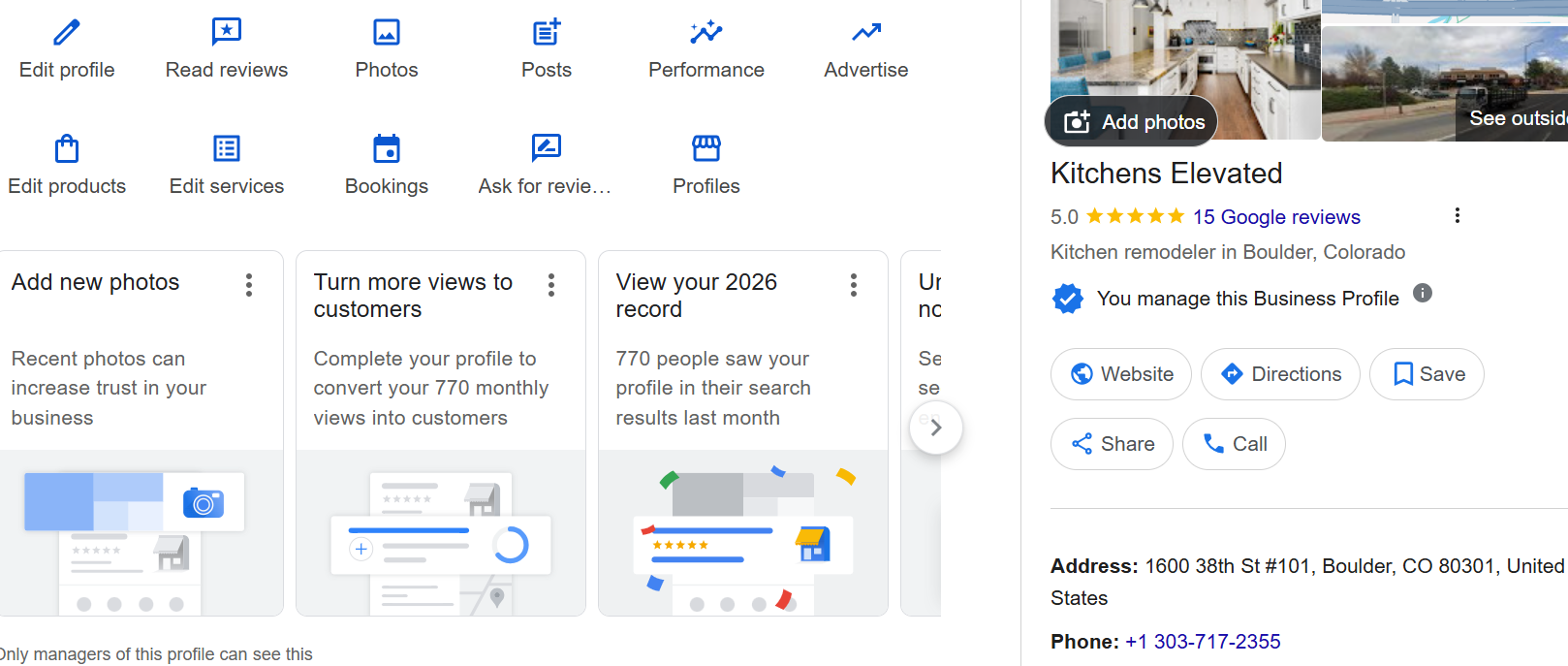
But a strong Google Business Profile strategy usually goes deeper than that. It should support your local SEO, match real search behavior, and help your business appear in Google Maps and organic search results for the right remodeling searches.
2. Build Consistent 5-Star Reviews
Reviews are not just a reputation tool.
They help homeowners decide whether to trust you.
A remodeler with strong reviews, detailed customer feedback, and real project photos has a different kind of credibility than a company with a thin profile and vague claims.
The key is consistency.
Not asking for reviews once every few months.
Not waiting until you remember.
Not hoping satisfied customers leave one on their own.
You need a simple process after completed jobs.
That might mean asking after the final walkthrough, sending a direct review link, and making it part of your closeout process.
This is one of the most practical SEO strategies because it helps with both search rankings and conversion. Reviews support visibility, but they also help potential customers choose you once they find you.
3. Launch Local Services Ads for Immediate Leads
SEO takes time.
That does not mean you should sit around waiting for search engine optimization to build momentum.
Local Services Ads can help create early traction while organic search is still growing.
For many remodeling companies, this can mean leads within the first 1–3 weeks if the setup is handled correctly.
But Local Services Ads should not replace SEO.
They should support the larger system.
The goal is not to become dependent on paid advertising forever. The goal is to use it strategically while your owned assets continue building.
4. Build and Optimize Your Website for Local SEO
Your website should not just “look nice.”
It should help homeowners understand what you do, where you work, and why they should call you.
For remodelers, that usually means clear service pages for:
- Kitchen remodeling
- Bathroom remodeling
- Basement finishing
- Whole-home remodeling
- Additions
- Exterior remodeling, if relevant
It also means location pages for the small cities and suburbs you actually serve.
This is where keyword research matters.
Not because you want to chase every keyword with high search volume, but because you need to understand how homeowners search for your services.

Your site should answer real search queries with valuable content that matches user intent.
That includes:
- Clear service descriptions
- Project examples
- FAQs
- Before-and-after proof
- Calls to action that are easy to find
- Mobile optimization so homeowners can call from their phone
This is also where many SEO companies get too generic. A remodeling website should not sound like every other contractor site. It should show the specific kind of work your business solves for homeowners in your market.
5. Ongoing SEO and Authority Building
This is where SEO begins to compound.
After the foundation is built, ongoing SEO work helps strengthen your site over time.
That can include:
- Improving service pages
- Publishing helpful SEO content
- Building location authority
- Earning quality backlinks
- Updating project pages
- Creating content around real homeowner questions
- Improving technical issues that affect your site’s SEO
This is where SEO costs should be judged carefully.
The question is not just, “What is the monthly fee?”
The better question is:
What is this SEO specialist or agency doing each month that moves us closer to booked jobs?
In most cases, remodelers should expect early traction in 2–4 months, with stronger compounding growth over time.
SEO remains a long-term channel. It is not instant like paid ads. But when it is built correctly, it can lower customer acquisition costs and create a steadier source of organic revenue.
6. Strategic PPC for Scaling or Expansion
PPC still has a place.
But it should come after the foundation is clear.
Once your website, tracking, reviews, and local visibility are in better shape, paid ads can help you scale.
For example:
- Expanding into a nearby city
- Promoting kitchen remodeling during a slower season
- Testing demand for higher-ticket services
- Supporting a new showroom or service area
The difference is control.
You are not using paid ads because everything else is weak.
You are using them to add fuel to a system that already works.
That is when paid advertising becomes more strategic and less stressful.
What Most Contractors Get Wrong About SEO
Most contractors get burned when SEO is treated like a standalone service.
They hire someone to “manage SEO,” but there is no clear connection to leads, calls, sales pipeline, or booked jobs.
That is where SEO stops feeling like a worthy investment.
Good SEO strategies should help you answer:
- Are we showing up for the right search results?
- Are we getting qualified traffic?
- Are calls being tracked?
- Are leads turning into estimates?
- Are estimates turning into signed jobs?
- Are our marketing dollars producing real returns?
Without that, SEO is just another expense.
With it, SEO is worth paying for because it becomes part of a predictable lead system.
FAQs
Is SEO worth it for small businesses like remodeling companies?
Yes, if it is built around local intent, tracking, and booked jobs.
No, if it is only focused on rankings, traffic, or generic content creation.
For remodelers, SEO is worth it when it helps you show up in search engines for homeowners actively looking for kitchen remodels, bathroom renovations, and home improvement projects in your service area.
Is it worth paying for SEO services?
It is worth paying for SEO services when the work is clear, measurable, and tied to real outcomes.
You should understand:
- What is being worked on
- Why it matters
- How it connects to potential clients
- How calls and leads are tracked
- Whether the leads are turning into jobs
It is not worth paying for SEO services if you are only getting vague reports and no clear connection to revenue.
How long does SEO take to work?
Most remodelers should think in terms of months, not days.
Local SEO improvements can sometimes show early movement sooner, especially if your Google Business Profile was underbuilt.
But meaningful SEO work usually takes 2–4 months to gain traction, then continues building over time.
That is why SEO is not a quick win. It is an initial investment in long term success.
SEO vs Google Ads — which is better?
They do different jobs.
Google Ads can create faster visibility.
SEO builds longer-term organic search visibility.
For most businesses, the strongest approach is not choosing one forever. It is using each at the right time.
Ads can support short-term demand.
SEO builds owned visibility that compounds.
Why did my last SEO company not get results?
Usually, one of three reasons:
- They focused on traffic instead of qualified traffic
- They used generic SEO strategies instead of local remodeling strategy
- They did not track calls, leads, or booked jobs clearly
Some SEO service providers also spend too much time on surface-level tasks and not enough time improving the parts of your website and Google presence that actually influence homeowners.
Can I do SEO myself?
Some parts, yes.
You can improve your Google Business Profile, ask for reviews, upload project photos, and create content from common homeowner questions.
But more technical work often needs an SEO specialist or experienced team.
That includes deeper keyword research, technical fixes, local SEO structure, tracking setup, content planning, competitive analysis, and understanding how ranking factors affect your market.
You do not necessarily need an in house SEO team. But you do need someone who can connect SEO work to real business outcomes.
Is SEO still worth it with AI search and AI generated answers?
Yes, but the standard is getting higher.
AI tools, AI search, and ai generated answers are changing how people find information. But homeowners still use search engines when they need local businesses they can call, compare, and trust.
For remodelers, SEO remains important because your visibility across Google, Maps, organic search results, and other search engines still shapes whether potential customers find you.
The goal is not to chase every new trend.
The goal is to build a strong online presence that helps homeowners trust you wherever they first discover your business.
Where Hector Fits Into This Without the Guesswork
Hector does not look at SEO as a standalone service.
Because remodelers do not need another disconnected marketing channel.
They need a system that helps them own their lead flow.
That means we care about:
- Calls, not just clicks
- Booked jobs, not just traffic
- ROI, not just reports
- Clear visibility, not confusing dashboards
- Long-term control, not rented leads
We build around the full picture: Google Business Profile, reviews, Local Services Ads, website structure, local SEO, ongoing authority, and tracking.
The point is not to make SEO sound complicated.
The point is to make it accountable.
If SEO is working, you should be able to see how it supports your sales funnel. You should know which marketing channels are producing real conversations and which ones are just burning budget.
A Real Remodeling Contractor Story
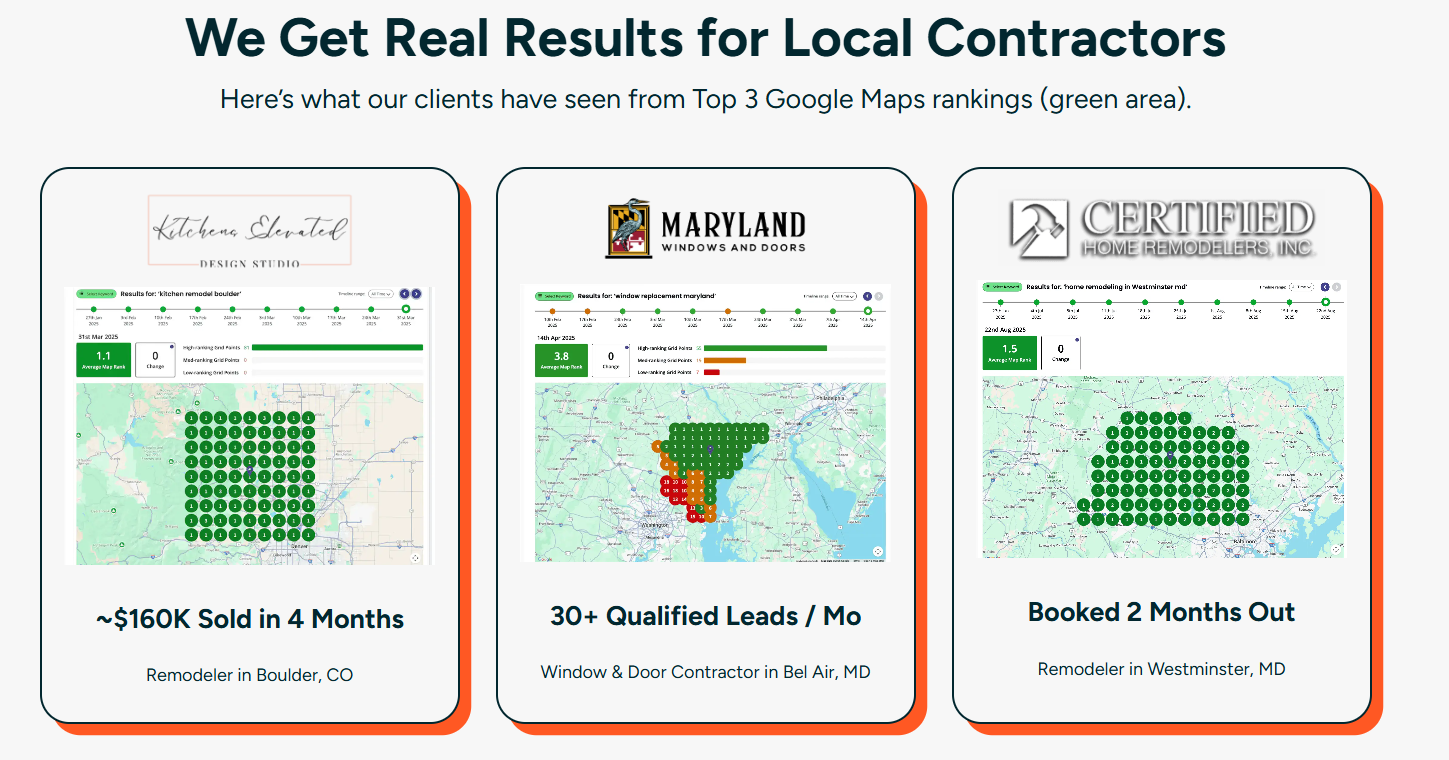
A remodeling contractor came to the same conclusion many family-owned businesses eventually reach.
Referrals were strong, but unpredictable.
Angi brought in leads, but too many turned into price-shopping conversations.
Some months were packed. Other months felt too quiet.
The business did good work. Homeowners trusted them once they got in the door. But the lead flow was not steady enough to plan around.
So the focus shifted.
Instead of chasing every possible lead source, they started building assets they owned:
- A stronger Google Business Profile
- More consistent reviews
- Clearer service pages
- Better local search visibility
- Tracking that showed where calls came from
- A website built around real remodeling search behavior
The change was not magic.
It was not one campaign.
It was a system.
Over time, they started seeing better conversations from homeowners who had already seen their work, read their reviews, and understood what they offered.
Less chasing.
Less price shopping.
More control.
If You’re Trying to Figure Out If SEO Is Worth It
Here is the honest answer.
SEO is worth it when it helps your remodeling business get found by the right homeowners, build trust before the first call, and track which leads turn into real jobs.
SEO is not worth it when it is disconnected from revenue.
So if you are asking:
“Is SEO worth it?”
The better question is:
“Do I have a system that turns visibility into booked remodeling jobs?”
Because that is what actually matters.
Not rankings by themselves.
Not traffic by itself.
Not reports that look good but do not tell you what happened after the phone rang.
If your current marketing cannot clearly connect to real jobs, that is the problem worth solving.
And if you want help thinking through what that system could look like for your remodeling business, Hector can help you get clarity.
No pressure. No big promises.
Just a practical look at where your leads are coming from, what is working, and what needs to be built next.
More From Hector