
Leads for Contractors: How to Generate Consistent Construction Clients
Leads for contractors are potential customers who search for professionals to complete construction, renovation, repair, or installation projects. Homeowners and property managers often look for contractors when they need services such as home remodeling, roofing, electrical work, plumbing, landscaping, or general construction. Most customers start this process online by searching for terms like contractors near me, home renovation contractors, or local construction services.
Contractors who appear in search results, local map listings, and targeted advertisements attract the majority of these high intent customers. This article explains what leads for contractors are, why many contractors struggle to generate consistent project inquiries, and how businesses can use SEO, digital advertising, and optimized service pages to create a reliable flow of qualified leads.
When the Phone Rings but the Jobs Don’t Follow
You paid for a batch of leads last month, and maybe only one turned into an actual job.
The rest?
A few quick phone calls that went nowhere. A homeowner asking for a rough price and then disappearing. Someone who said they were “still talking to a few contractors.” One estimate appointment that canceled the morning of.
For a lot of general contractors and residential contractors, this experience is painfully familiar.
The problem isn’t that your lead generation efforts aren’t producing activity. In fact, many contractors today are getting plenty of inquiries. The real issue is that most of those leads for contractors never turn into serious projects.
They’re price shoppers.
They’re early researchers.
They’re homeowners clicking through a lead generation platform and sending the same request to five different contractors.
So while the phone rings, the jobs don’t follow.
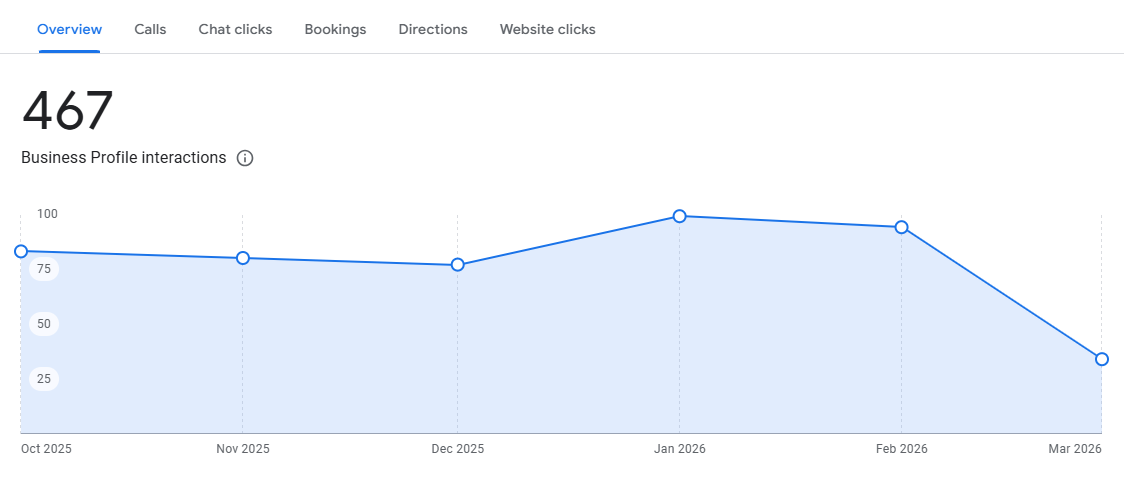
Many construction companies spend thousands every year on lead generation services, paid advertising, or pay per lead platforms hoping to generate leads for their construction business. Yet they still struggle to build a steady stream of reliable work.
What most contractors eventually realize is this:
Not all leads are created equal.
Some inquiries come from systems that produce random construction leads. Others come from systems designed to attract qualified leads, local homeowners who are actually ready to hire someone.
And the difference almost always comes down to how the lead was generated in the first place.
A strong lead generation strategy isn’t about chasing more leads. It’s about understanding where high quality leads actually come from and building a lead generation process that consistently attracts them.
Because once you understand that difference, your entire contractor lead generation approach changes.
Why Most “Leads for Contractors” Stop Producing Real Jobs
The construction industry has no shortage of marketing options.
Every week there seems to be another lead generation website, marketing agency, or new platform promising to help contractors generate leads. Some offer pay per lead programs. Others focus on search engine marketing, social media platforms, or paid ads like Google Ads.
But many contractors eventually discover the same pattern.
They get activity…
but not consistent, valid leads that turn into real projects.
Here’s why.
Lead-Buying Platforms Create Price-Shopping
Many contractors rely on large lead generation platforms like Angi, HomeAdvisor, or Thumbtack to get construction leads.
These systems often operate on a pay per lead model. A homeowner submits a request, and the platform sells that same inquiry to multiple contractors.
From the contractor’s perspective, it looks like a new opportunity. You receive a billable lead, you make a call, and you hope it turns into work.
But from the homeowner’s perspective, they’ve just triggered a bidding war.
Within minutes, several construction professionals may be calling them about the same project. Now the conversation becomes less about reputation and more about price.
That’s why many contractors notice that pay per lead programs often produce price-shopping conversations rather than serious projects.
Agencies Often Report Activity, Not Results
Another common frustration comes from marketing agencies.
Many agencies focus heavily on online marketing metrics like clicks, impressions, or website traffic. They may show charts from search engine optimization, content marketing, or email marketing campaigns.
Those numbers can look impressive.
But contractors rarely see the one metric that actually matters:
How many qualified leads turned into signed jobs?
For a business owner running a contracting business, the question isn’t how many visitors a website gets. The question is how many potential clients called, scheduled estimates, and became new clients.
Without clear tracking of phone calls, contact forms, and booked projects, even the best-looking marketing efforts can feel disconnected from real revenue.
PPC Can Produce Leads: But Also Burn Budget Fast
There’s no question that Google Ads and other search engine marketing campaigns can generate leads.
When someone searches for construction services in their area, targeted paid advertising can place your company directly in front of them.
But there are two challenges.
First, the lead cost has risen dramatically in many markets. Contractors often need a substantial monthly budget just to compete for visibility in the search engine results.
Second, without strong tracking systems, it’s difficult to know exactly how many valid leads came from those campaigns.
Many contractors spend thousands on paid ads, only to discover later that the potential customers they attracted weren’t ready to move forward.
Referrals Are Great: But They’re Not Predictable
Most contractors will say their best clients still come from word of mouth.
A referral from past clients, existing customers, or even real estate agents often produces some of the best projects.
These leads already trust you. They’ve seen your work. They usually close quickly.
But referrals have one limitation.
They’re unpredictable.
One month your construction company might get several referrals from happy customers. The next month things go quiet.
For contractors trying to build a reliable contractor lead generation system, referrals alone rarely create the steady stream of opportunities needed to grow.
The Real Problem: Spikes Instead of Systems
If you look closely at most contractor marketing, it follows the same pattern.
A lead generation platform produces a few inquiries.
A Google Ads campaign generates some new leads.
A referral comes in from a past client.
Then things slow down again.
The activity comes in waves instead of a predictable flow.
The problem isn’t that these marketing channels never work. Many of them can produce good leads from time to time.
The real issue is that they rarely create a system contractors actually control.
When your lead flow depends on rented platforms, fluctuating pay per lead programs, or unpredictable referrals, you’re always reacting to whatever the market sends your way.
Where Qualified Leads for Contractors Actually Come From Today
If many traditional marketing approaches create inconsistent results, where do qualified leads actually come from today?
For most contractors, the answer is simpler than it appears.
When local homeowners are ready to hire someone, they usually start in one place:
Google Search.
Whether they need a kitchen remodel, foundation repair, roofing work, or other construction services, their first step is usually to open a search engine and look for a local company.
A homeowner might type something like:
- “bathroom remodel contractor near me”
- “foundation repair contractor in Dallas”
- “kitchen remodeling company near me”
At that moment, they’re not browsing casually.
They’re actively looking for someone to hire.
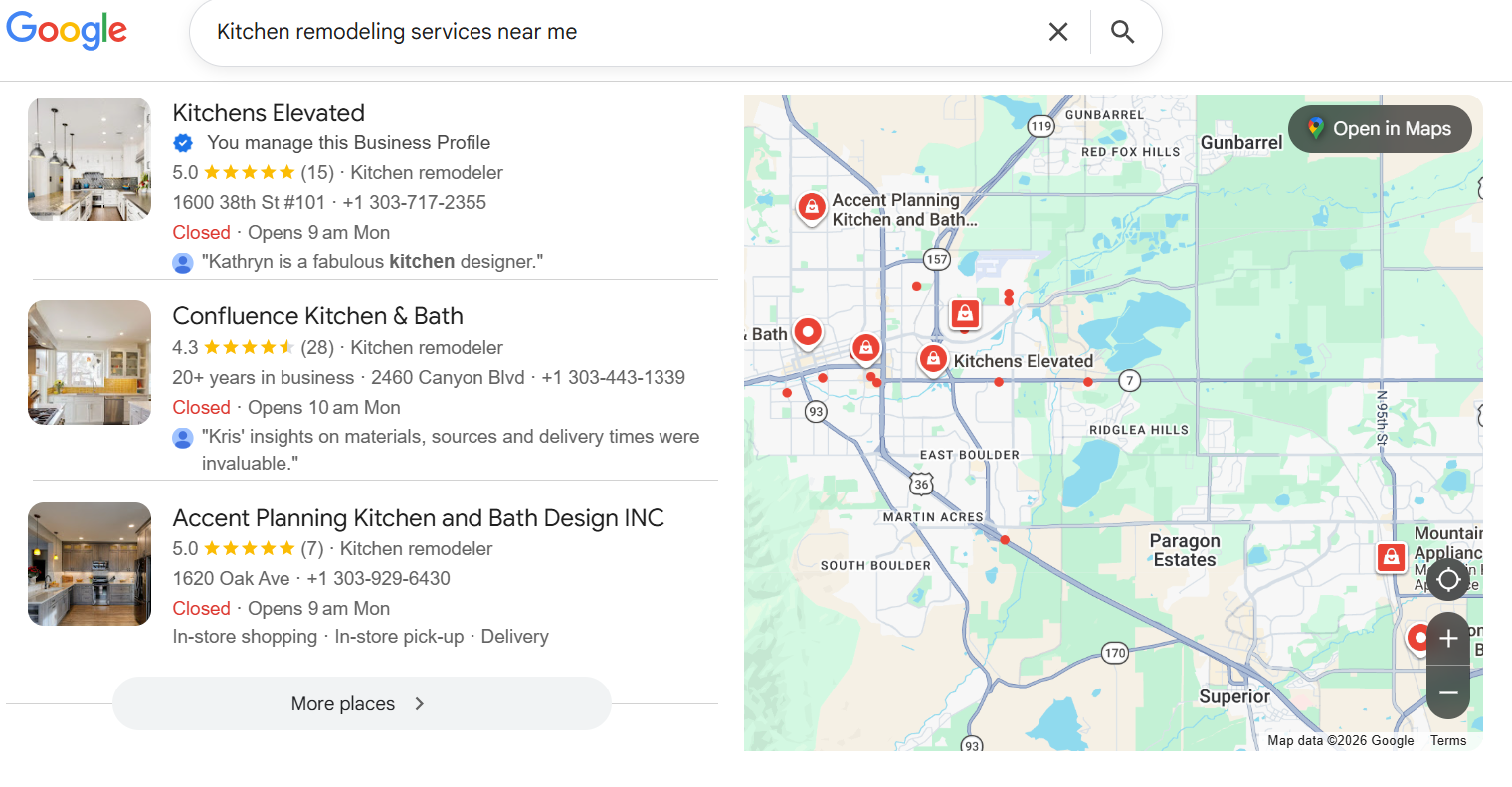
That’s why strong construction lead generation today often focuses on visibility in Google Search and Google Maps—because that’s where serious buyers are already searching.
Google Maps Has Become the Modern Billboard
For many local businesses in the home services industry, Google Maps now functions like the modern version of a billboard.
When a homeowner searches for a contractor, they immediately see a list of local companies with:
- star ratings
- positive reviews
- photos of completed projects
- phone numbers
- service areas
This information comes directly from the contractor’s Google Business Profile, which has become one of the most important tools for local visibility.
Contractors with a strong online marketing presence in Google Maps are often the first companies homeowners call.
Reviews and Proof Matter More Than Ads
When homeowners see several contractors in a Google Maps listing, they don’t just click the first name they recognize.
They start comparing.
They look at:
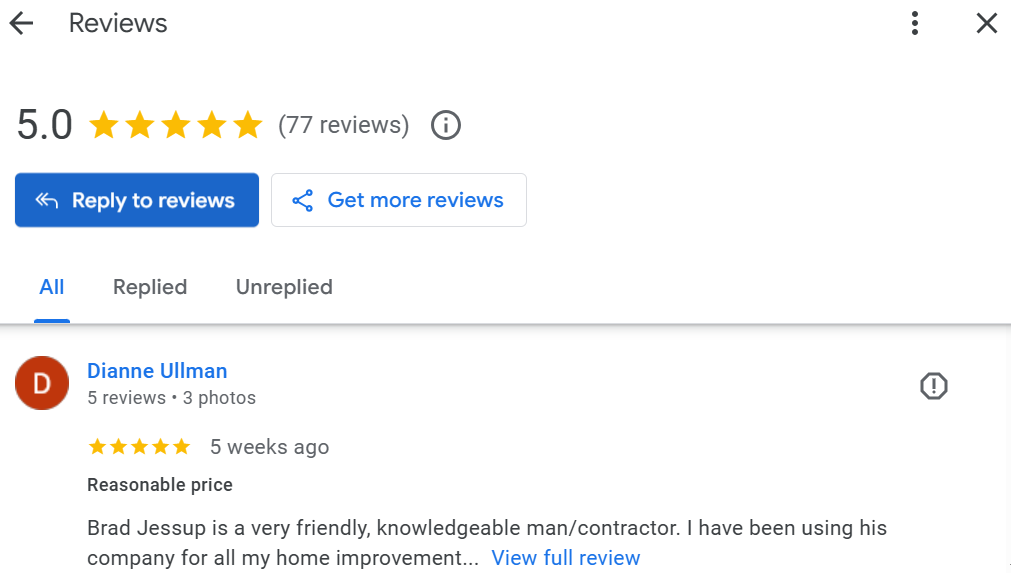
- how many reviews each contractor has
- the quality of those positive reviews
- project photos
- whether the company looks established and trustworthy
In many cases, the contractor with the strongest reputation and most visible proof gets the call.
That’s why a strong online presence—especially on Google Business Profile—has become such a powerful part of modern lead generation strategy for contractors.
Why These Leads Turn Into Real Jobs
There’s a fundamental difference between the way most lead generation websites create inquiries and the way local search produces qualified leads.
It comes down to intent.
When someone fills out a form on a lead generation platform, they may simply be exploring options. They might be weeks—or even months—away from making a decision.
But when someone searches directly on a search engine for a contractor in their city, their mindset is different.
They’re usually:
- researching the project seriously
- comparing a small number of contractors
- preparing to move forward
These are potential customers who already know they want the work done. They’re simply deciding which company to trust.
That’s why many contractors notice that leads coming from Google Search, Google Maps, or their own lead generation websites often produce high quality leads rather than random inquiries.
Random Leads vs Qualified Leads
| Random Leads | Qualified Leads |
|---|---|
| Shared with multiple contractors | Direct search |
| Price-shopping conversations | Reputation-driven decisions |
| Cold inquiries | Intent-driven homeowners |
When someone is searching locally for a contractor, they’re typically looking for a local company with strong reviews and visible experience.
That’s very different from someone casually clicking through a pay per lead website.
A Real Contractor Scenario
Imagine a homeowner searching:
“bathroom remodel contractor in Fort Worth.”
They’re not browsing social media posts.
They’re not casually exploring home improvement ideas.
They’re looking for someone who can do the work.
They’ll usually call two or three contractors that appear trustworthy in Google Maps. They’ll compare reviews, maybe visit a website, and then schedule an estimate.
That’s why contractors who focus on attracting exclusive leads from search tend to see better results than those relying only on pay per lead programs.
At this point, many contractors start to see the pattern.
Random inquiries usually come from platforms where the contractor is competing with multiple companies at once.
Real opportunities—those qualified leads that turn into projects—tend to come from places where homeowners are actively searching for a trusted local contractor.
Which leads to the real question.
If Google Search, Google Maps, and a strong online presence are where serious homeowners are looking…
how do contractors actually build a system that produces those kinds of leads consistently?
That’s where a structured approach to contractor lead generation begins to matter.
The 6-Step System That Turns Visibility Into Predictable Contractor Leads
Once a contractor understands where qualified leads come from, the next step is building a system that produces them consistently.
This is where a lot of lead generation efforts break down. Contractors may have one piece working—a decent Google Business Profile, some positive reviews, or a website, but not a full lead generation strategy that connects visibility, trust, tracking, and follow-up.
A predictable contractor lead generation system is built in layers. Some improvements can happen quickly. Others take consistent effort and time to compound. But when the pieces work together, they create something most contractors actually want:
Not just more activity.
Not just more new leads.
A more reliable flow of qualified leads from local homeowners who are ready to move forward.
Step 1 – Optimize Your Google Business Profile
For many contractors, this is the fastest place to improve visibility.
A fully optimized Google Business Profile helps your business appear in Google Maps when homeowners search for local services. It also helps Google understand exactly what you do, where you work, and which service categories apply to your company.
That means your profile needs more than a business name and phone number.
It should include:
- accurate primary and secondary service categories
- a clearly defined service area
- recent project photos
- complete business information
- service descriptions that match what homeowners are searching for
For many home services companies, this is one of the few parts of the lead generation process that can be improved immediately.
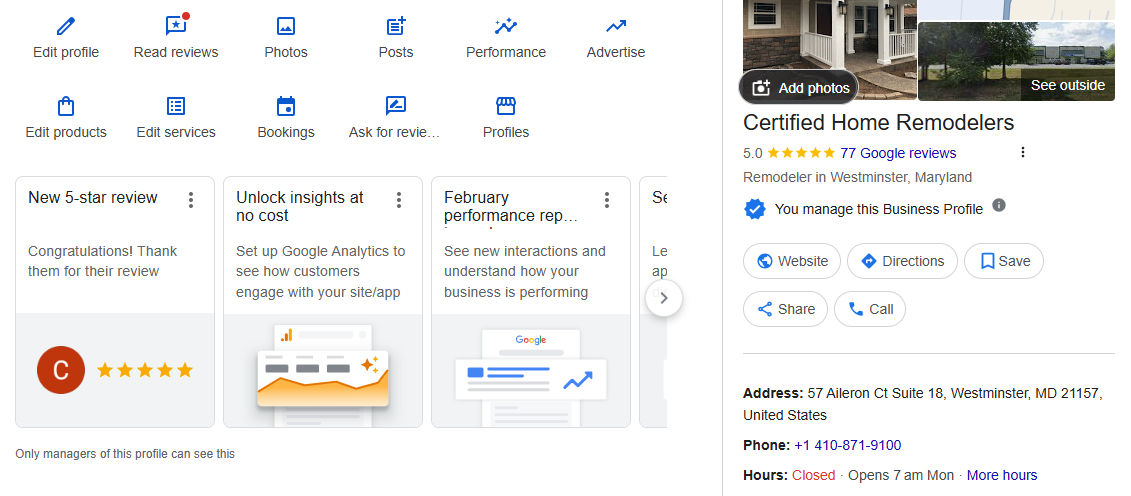
A contractor can clean up categories, update service descriptions, upload new photos, and tighten up business information without waiting months for results. It won’t solve everything by itself, but it lays the groundwork for stronger local visibility.
The goal here is simple: make it easier for potential customers to find you and trust what they see.
Step 2 – Build Consistent 5-Star Reviews
Once your profile is in shape, the next leverage point is reviews.
Reviews do two jobs at once.
They help your company perform better in local search, and they help convert searchers into calls. In other words, reviews support both search engine optimization and lead quality.
Most contractors already know reviews matter. The mistake is treating review collection like an occasional task instead of an ongoing part of the business.
The contractors who win in Google Maps usually have a consistent review habit. They ask after successful projects. They make the process easy. They keep building visible trust over time.
This is one of the clearest examples of how lead generation becomes predictable. You are not hoping a platform sends you exclusive leads. You are building public proof that helps attract future clients month after month.
For many construction companies, this is another area that can improve right away with internal follow-through. The actual ranking impact may take time, but the trust impact starts immediately.
Step 3 – Launch Local Services Ads (LSA)
For contractors who want faster traction while local visibility grows, Local Services Ads can be a strong middle step.
LSA works differently than traditional Google Ads. Instead of classic click-based paid advertising, this model is closer to pay per lead. Contractors typically pay per lead rather than per click, which can make the early math easier to understand.
That does not mean every lead is perfect. But when LSA is set up properly—with the right service categories, service area, reviews, and screening—it can start producing calls in the next 1–3 weeks.
That makes it useful for contractors who need near-term momentum while longer-term search engine optimization work builds.
It also gives contractors a better way to evaluate performance than many generic lead generation services. Instead of looking at vague activity, they can review how many calls, messages, and booked appointments actually came through.
This is often where business owners start seeing the difference between rented activity and a structured local lead system. LSA is still platform-based, but when it sits alongside your own reputation, your own profile, and your own tracking, it becomes part of a broader system—not your entire strategy.
Step 4 – Build a Website That Supports Local SEO
A strong website should do more than exist.
It should help contractors attract potential clients, support rankings, answer homeowner questions, and turn visits into calls.
A lot of contractor websites fail here. They may look decent, but they don’t clearly explain services, show enough proof, or create enough location relevance to support a real construction lead generation plan.
A better site does a few practical things well:
- clearly explains the specific construction services you offer
- shows project photos that build trust
- includes useful service pages for the work you actually want
- makes contact forms and phone numbers easy to find
- reinforces the cities and neighborhoods inside your service area
This is where many contractors need expert help. A website that supports local rankings and conversion is usually more strategic than a basic brochure site. The structure matters. The content matters. The local relevance matters.
It is also why many generic lead generation websites underperform. They may capture a form here and there, but they are not built to support a long-term lead generation strategy.
Step 5 – Ongoing SEO That Builds Authority Over Time
This is where predictability starts to compound.
Local SEO is not one change. It is an ongoing system built around relevance, authority, and consistency. For contractors, that often includes:
- city-specific service pages
- project-based content
- stronger internal site structure
- backlink and citation work
- better alignment with what homeowners actually search in a search engine
Over time, this builds authority for both the website and the business itself.
This is why search engine optimization is such an important part of contractor lead generation. Unlike short bursts from rented platforms, SEO can keep producing opportunities long after the original work is done.
That is also why many contractors eventually shift their thinking. Early on, they look for a quick local lead generator for contractors. Later, they realize the real win is building an asset that keeps generating visibility in Google Search and Google Maps.
This is not overnight work. In most markets, contractors should expect meaningful movement over 2–4 months, with stronger momentum building after that. The timeline depends on competition, market size, existing authority, and how much work has already been done.
This step almost always requires expert support if the contractor wants to do it well and do it efficiently. But it is also the part that creates the most durable long-term value.
Step 6 – Strategic PPC for Scaling
PPC still has a place.
But it works best when it is built on top of a system that already has traction.
When a contractor already has a strong Google Business Profile, solid reviews, a website that converts, and working tracking, PPC becomes a scaling tool. It can help expand into new service categories, reach nearby markets, or capture additional demand in high-value segments of residential construction.
That is very different from using paid ads as a substitute for strategy.
Without the right foundation, PPC often becomes expensive guesswork. With the right foundation, it can become a smart way to add volume and test new opportunities.
This is why the best lead generation strategy for contractors usually is not “run more ads.” It is build the system first, then use search engine marketing selectively where it makes business sense.
FAQs
Why do so many leads for contractors turn into price shoppers?
Because many of those leads come through shared systems.
When a homeowner fills out a request on a lead generation platform, that inquiry may go to several contractors at once. By the time you call, the homeowner may already be comparing multiple prices. That makes it harder to stand out on trust, experience, or quality.
In contrast, contractors who show up in Google Search, Google Maps, or their own websites are more likely to receive exclusive leads from people who chose to contact them directly.
What is the best local lead generator for contractors today?
For most contractors, the best local lead generator for contractors is not a single platform.
It is a system built around Google Business Profile, Google Maps, local SEO, reviews, and clear tracking. That combination helps contractors show up where local homeowners are already looking and turn that visibility into better leads for contractors.
Some paid channels can help, but the strongest systems are the ones the contractor actually owns.
How long does contractor SEO take to produce leads?
It depends on the market, the competition, and the starting point.
LSA can sometimes produce traction in 1–3 weeks. Local SEO usually takes longer. In many markets, contractors begin seeing stronger movement after 2–4 months, with results improving as authority builds.
That slower start is exactly why some contractors get frustrated and quit too early.
The better way to look at it is this: SEO is not a quick fix. It is part of a compounding system. Once it starts working, it can keep producing qualified leads without the same dependence on rising lead cost or outside platforms.
Are paid ads still worth it for contractors?
Yes—when they are used strategically.
Google Ads, LSA, and other forms of paid advertising can absolutely help generate leads. But they work best when they are layered onto a strong foundation. If the website is weak, the reviews are thin, and tracking is missing, then ad spend often hides bigger problems instead of solving them.
A smart contractor uses paid ads to support growth, not to replace the rest of the system.
How can contractors stop relying on shared lead platforms?
Usually not by turning them off overnight.
A better approach is to reduce dependency by building owned visibility step by step. Improve your Google Business Profile. Build reviews. Strengthen your website. Invest in local SEO. Track which channels bring real jobs.
As those channels begin producing high quality leads, the contractor becomes less dependent on any one outside source. That is how control comes back into the business.
Where Hector Fits Into This System
This is the part many contractors have been missing.
Not another platform.
Not another vendor sending reports full of vanity metrics.
A partner who helps build the actual system.
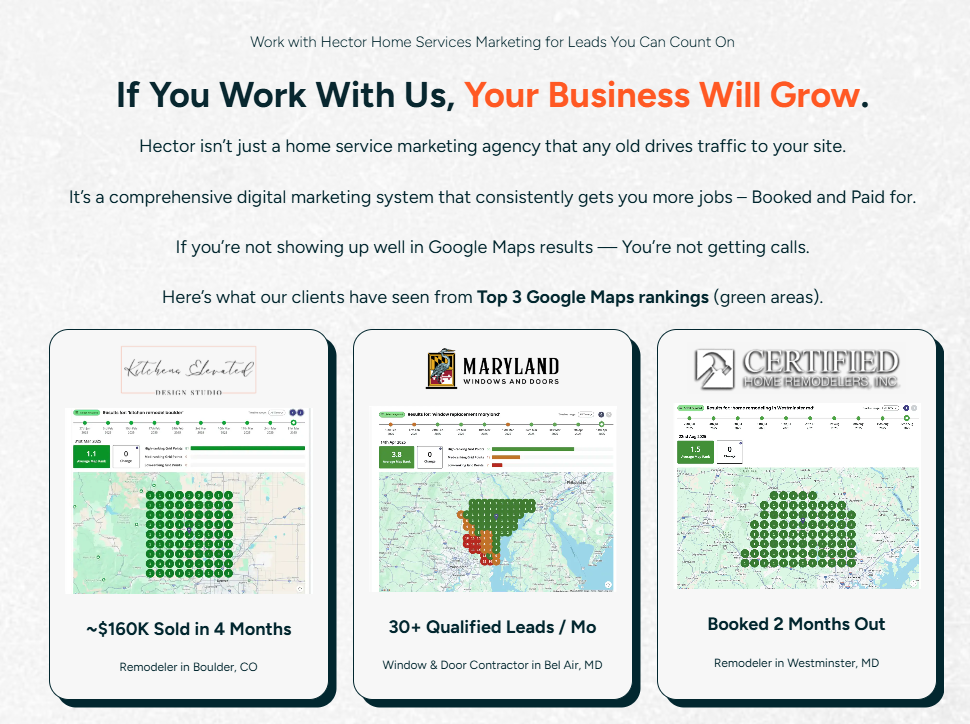
Hector works with family-owned contractors who want to stop guessing which marketing efforts are working and start seeing clearer connections between visibility, phone calls, booked estimates, and revenue.
That means helping contractors:
- build systems they own
- improve visibility in Google Search and Google Maps
- strengthen reviews and local trust
- track calls and booked jobs instead of just traffic
- make better use of marketing budget over time
The point is not to lock contractors into confusing generation services or endless long term contracts.
The point is to help them build a lead system that fits their business needs, supports their market, and creates more stability in the business.
A Story From the Field: From Random Leads to Predictable Jobs
One of the most common patterns looks like this.
A contractor starts with a mix of Angi leads, referrals, and maybe a few Google Ads campaigns. Some months feel decent. Other months are thin. The phone rings, but too many conversations go nowhere. The contractor keeps buying construction leads, hoping the next batch will be better.
Eventually, the frustration is not just about the money.
It is about not knowing what is actually working.
Then the focus shifts.
Instead of chasing whatever lead generation services are being sold that month, the contractor starts building local visibility. The profile gets cleaned up. Reviews begin coming in more consistently. The website gets stronger. Local SEO starts supporting the market. Tracking improves.
Now the calls coming in look different.
The homeowner has already seen the reviews.
They have already looked at the photos.
They already believe the contractor might be a fit.
That changes the conversation from the start.
The job is no longer to convince a cold lead to take you seriously. The job is to help a serious homeowner decide whether you are the right company.
That is a very different position to operate from.
If You Want Better Jobs, Not Just More Leads
Most contractors do not actually need more inquiries.
They need better inputs.
They need a system that helps the right homeowners find them, trust them, and reach out at the right time. That means stronger visibility, stronger proof, stronger tracking, and a better lead generation process from first search to booked job.
That is the real difference between random inquiries and real, qualified jobs.
One depends on whatever a rented platform happens to send.
The other is built through a system the contractor can improve, measure, and own.
If your current lead generation strategy still feels unpredictable, that is usually a sign the business does not need more activity.
It needs a more controlled way to generate leads.
A Simple Conversation If You Want Clarity
If you want a clearer picture of why your current leads for contractors feel inconsistent, or what a more predictable system could look like in your market, that conversation does not need to be complicated.
Sometimes it just helps to step back, look at where your current leads are coming from, what those channels are really producing, and where the gaps are.
No pressure.
No hype.
Just a practical look at what is working, what is not, and what it would take to build a system that brings in better jobs more consistently.