
How To Get Home Renovation Leads That Actually Works?
You spent $4,000 on renovation leads and home renovation leads from Angi.
You met with five homeowners and potential customers.
- Two were price shopping (multiple contractors).
- One stopped responding.
- One said they’re “waiting until next year.”
- You closed one bathroom remodel from one lead.
Then the next month? The phone slows down. And you don’t know why.
That’s the stress point for a lot of family-owned remodelers and most contractors in the remodeling industry. Not the work. The unpredictability.
It’s not that you can’t sell.
It’s not that your craftsmanship isn’t strong.
It’s that your home renovation leads, renovation leads, and home remodeling leads feel random—and your schedule shows it.
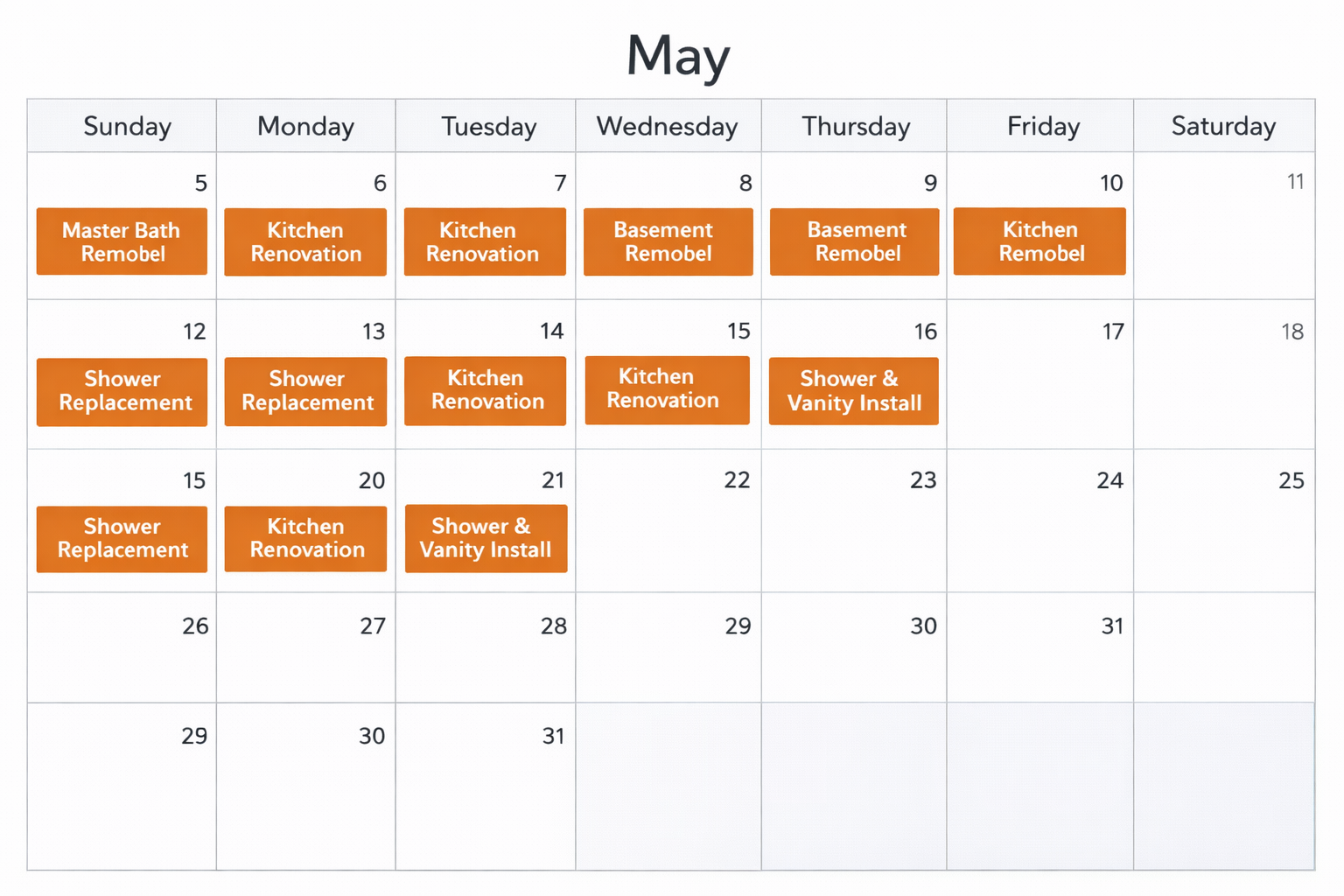
One month you’re buried in kitchen remodel estimates in your home remodeling business. The next month you’re looking at gaps and wondering if you should hold off on hiring, slow spending, or push your crews harder to fill the schedule with more jobs and upcoming projects.
We hear this constantly from contractors and general contractor owners:
“We’re spending money on lead generation, but we can’t clearly tie it to signed renovation contracts.”
You might be getting inquiries from serious homeowners and prospects. But when you look at booked consultations and signed projects, the connecting thread feels fuzzy.
That’s not a “try harder” problem.
It’s a system control problem in your lead generation process.
A Scenario That Feels Familiar
You walk through a detailed kitchen remodel estimate for a home renovation.
You’ve got a strong portfolio.
You’ve got solid reviews.
The homeowner seems excited.
Then they say:
“We’re meeting with multiple contractors.”
You already know what that means.
Now it’s not about value—it’s about price comparison and budget.
That situation isn’t random.
It’s structural—and it can leave your pipeline blocked.
What the Numbers Usually Reveal
When we look inside a remodeling company’s CRM pipeline, we often see something like this (real time):
- 14 leads in January
- 6 leads in February
- 11 leads in March
- 3 leads in April
No clear pattern. No consistency. No predictability.
That kind of revenue swing makes it hard to:
- Plan hiring and management
- Invest confidently
- Schedule crews and subcontractors
- Grow without stress
This isn’t about getting more renovation leads, more home renovation leads, or more home remodeling leads.
It’s about building something predictable—so the system delivers.
Why Most Renovation Lead Sources Stop Working Over Time
Most remodelers aren’t failing at marketing or lead generation. They’re using lead generation services and lead sources that were never designed for control in a remodeling business.
Referrals : Strong but Unpredictable
Referrals are valuable. Some of the best kitchen and bathroom remodels come from past clients and customers in home improvement.
But referrals are not scalable.
They dry up unexpectedly.
They depend on someone else starting a conversation about you.
You can’t control timing.
We’ve seen remodeling companies where referrals carried the business—until one slow quarter created a gap in the schedule you have to fill.
Referrals are a powerful bonus.
They are not a predictable system.
Shared Platforms (Angi, Thumbtack, HomeAdvisor) : Built for Competition, Not Control
Here’s how shared home renovation leads and home remodeling leads work:
- A homeowner fills out one form.
- Three to five contractors receive the same lead (remodeling leads).
- Everyone calls at once.
Now you’re not just presenting your work. You’re defending your price and pay.
We hear this constantly:
“We paid for 12 leads and booked one job.
And the one job we did book barely made sense after the discount we had to give. We were competing with four other contractors on the same lead.”
This model creates predictable problems:
- Shared lead price competition
- A race to the bottom on price
- Paying for low-quality renovation leads and remodeling leads
- Lack of exclusivity
- Dependency on rented platforms and access-based lead generation services
If you stop paying, the flow stops.
That’s not ownership.
That’s renting your pipeline in a way that doesn’t support long-term control.
Trade Shows & Home Expos : Spikes, Not Systems
Home shows can feel productive.
You gather dozens of contacts in a weekend (traditional advertising).
You schedule consultations for the next few weeks.
Then what?
Two months later, the calendar slows down again.
We’ve worked with remodelers who relied heavily on expos. The pattern was always the same:
- Big spike after the event
- Long quiet stretch afterward
Event-based marketing creates bursts. It does not create consistent renovation leads, home renovation leads, or home remodeling leads month after month.
Bath Doctor Bathroom Remodeling in Baltimore experienced this firsthand. For years, home shows and referrals carried their bathroom remodeling business. After each event, the schedule filled up with projects for several weeks.
But once the event momentum wore off, the pipeline thinned out again. The team was constantly reacting to spikes instead of operating from a predictable system — and over time, that instability created real financial pressure.

Google Ads Without Proper Tracking : Easy to Spend, Hard to Measure
Google Ads can generate renovation leads, remodeling leads, and home remodeling leads.
But in remodeling, clicks are expensive. “Kitchen remodel near me” is competitive. Cost per click keeps rising in your market.
Without proper tracking tied to actual signed contracts, it becomes easy to:
- Spend thousands
- See activity in the account
- Still not know what turned into revenue in real time
We often see reports full of clicks and impressions—but no visibility into ROI, management clarity, or credit-safe decisions.
As we tell contractors:
Visibility without tracking is guessing.
PPC works only with structure.
Otherwise, it feels like gambling.
The Pattern Behind the Frustration
When you step back, it becomes clear:
- Referrals are unpredictable.
- Shared platforms create competition and dependency.
- Trade shows create spikes.
- PPC without tracking creates uncertainty.
Spikes don’t build a pipeline.
So if those aren’t delivering consistency, where does predictability actually come from in the lead generation process?
Where Predictable Home Remodeling Leads Actually Come From Now
If you want consistent home renovation leads, renovation leads, home remodeling leads, and remodeling leads, you have to look at where serious homeowners are already making decisions in home remodeling and home improvement.
That’s Google Search and Google Maps.
Google Search & Google Maps : The Modern Billboards
When someone searches:
- “kitchen remodeling company near me”
- “bathroom renovation contractor [city]”
- “home addition contractor reviews”
They’re not browsing casually. They’re selecting who to call, who to contact, and who to speak with.
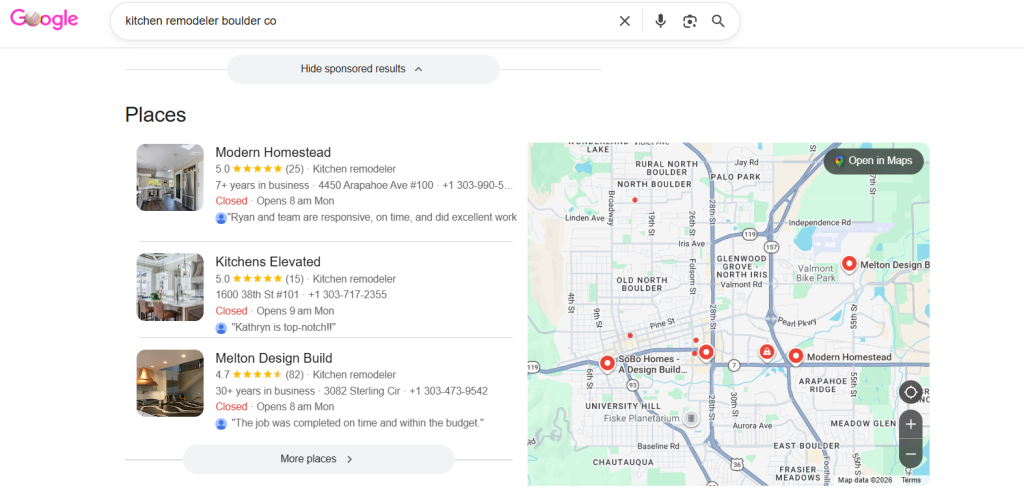
In small and mid-sized markets, there is often less digital competition than contractors assume.
That creates opportunity.
You don’t need a national budget to show up consistently in your town. In most small markets, consistency beats budget—especially when big competitors aren’t paying attention locally.
Local search intent is powerful because it’s bottom funnel. They already want the renovation done, and their research is happening before they ever contact your office.
Reviews, Photos, and Proof Close Before You Even Show Up
By the time you show up for an estimate, the homeowner has already narrowed their list.
They’ve read reviews.
They’ve looked at project photos.
They’ve compared reputations and brand trust.
Organic renovation leads close higher than shared leads because:
- There’s less price competition
- Trust is built upfront
- The homeowner chose you
We saw this clearly with a bathroom remodeling company that stopped relying on events and shared platforms and built local search visibility in their core market—on purpose.
Within months, they weren’t just getting more home renovation leads. They were getting better ones—prospects who matched their quality expectations.
Which leads to the next question: how does this visibility actually turn into signed contracts?
How Visibility Turns Into Signed Renovation Contracts
When the system works, the path is simple:
- A homeowner searches for a remodeler or general contractor.
- You appear in the top 3 Map results.
- They check your reviews.
- They click your website.
- They see clear services and real projects.
- They call and contact you.
- You book the consultation and appointment.
- You sign the contract.
Visibility → trust → contact → booked job.
When that chain is consistent, your lead flow stops feeling random—and your management decisions get easier.
A Real Scenario
One remodeling contractor came to us after a slow February.
They weren’t new.
They weren’t inexperienced.
They just weren’t visible where it mattered in their market.
After improving their Google Maps visibility and tightening call tracking, something changed within 4–6 weeks:
- Calls increased
- The conversations were higher quality
- Fewer price shoppers
- More serious homeowners
When we compared performance, the difference was clear:
- Shared leads closed lower.
- Organic leads closed higher.
Add in strong reviews and fast response times, and bookings increase even more:
- Reviews increase close rate.
- Speed to response increases bookings.
- Lead quality matters more than lead quantity.
This is where the shift happens.
You stop chasing renovation leads and remodeling leads.
You start building a system that produces them consistently—and the system delivers predictable jobs.
So how do you turn this into something structured and predictable—month after month?
The Hector 6-Step Predictable Renovation Lead System
If you want predictable home renovation leads, home remodeling leads, and remodeling leads, you need a system you control—not a patchwork of random tactics or disconnected lead generation services.
This progression matches how homeowners actually choose a remodeler:
- First, they see you (Maps + Search)
- Then they trust you (reviews + proof)
- Then they contact you (calls + forms)
- Then you track it (so you know what’s working in real time)
- Then you compound it (so results don’t disappear next month)
Here are the six steps, in order.
Step 1: Optimize Your Google Business Profile
Your Google Business Profile is the fastest “owned” lever most remodeling companies have.
If your profile is weak, wrong categories, outdated photos, no service clarity—you can be a great contractor and still get buried.
What to dial in:
- Categories & services: Don’t just list “Contractor.” Be specific (kitchen remodeling, bathroom remodeling, home additions, general contractor).
- Service areas: Make sure your coverage matches where you actually want projects in your service area.
- Photos: Real before/after jobs in your market, uploaded consistently (project photos).
- Description: Clear, homeowner-friendly, focused on what you actually do.
- Weekly activity: Fresh updates signal legitimacy and relevance.

This isn’t “SEO theory.” It’s visibility.
In small and mid-sized cities, local reputation matters more, and it’s often easier to dominate Maps when you’re consistent.
Timeline: Immediate traction is possible—sometimes within days or weeks.
What you can do now vs later:
- You can improve today: categories, photos, services, description, hours
- Usually needs expert support: strategy alignment, competitive analysis, optimization cadence, and management reporting
Step 2: Build Consistent 5-Star Reviews
Reviews are not “nice to have” in remodeling.
A homeowner about to spend $25k–$150k doesn’t want risk. Reviews reduce the fear and boost trust.
What matters most:
- Review velocity: Are you getting reviews consistently?
- Recency: Do you have reviews from the last 30–60 days?
- Detail: Do they mention the project (bathroom remodel, kitchen renovation, addition)?
A practical review system looks like:
- Ask at the right moment (after walkthrough, punch list complete, homeowner excited)
- Make it easy (direct link, short instructions)
- Follow up once (not five times)
- Build it into your process so it happens whether you “remember” or not—with team support
Timeline: 30–60 days to see noticeable impact.
What you can do now vs later:
- You can improve today: ask process, link setup, response habits
- Usually needs expert support: automation tied to CRM + follow-up, training, and reporting
Step 3: Launch Local Services Ads
If you want faster traction while organic visibility compounds, Local Services Ads can help.
LSA often shows above Maps and runs on a pay-per-lead model—not pay-per-click.
That matters because:
- You’re not paying for tire-kickers clicking around
- You’re paying for a lead that actually contacted you
But it works best when your foundation is in place:
- Strong Google Business Profile
- Strong review profile
- Tight service categories (so leads match your work)
And it must be tracked, or you’re right back in guessing mode.
Timeline: Often 1–3 weeks to see activity, depending on market and setup.
What you can do now vs later:
- You can improve today: review strength, service alignment, responsiveness
- Usually needs expert support: setup, lead filtering, tracking and attribution, and account management
Step 4: Build & Optimize Your Website for Local SEO
Your Google Business Profile gets you seen.
Your website gets you chosen.
If your site is thin, generic, or doesn’t match what homeowners are searching for, you’ll keep getting “maybe” leads—people who aren’t ready, aren’t qualified, or are just collecting bids.

At minimum, you want dedicated pages for:
- Kitchen remodeling
- Bathroom remodeling
- Home additions
Those pages should do the job of a good estimator:
- Clarify what you do (and what you don’t)
- Show proof (before/after, remodeling photos, reviews)
- Explain your process so the homeowner feels safe
- Make the next step obvious (call, form, consultation)
Local SEO takes time, but it compounds—because you’re building an asset you own, not renting attention.
Timeline: Typically 2–4 months to see traction, then it builds.
What you can do now vs later:
- You can improve today: project images, clearer service descriptions, conversion path
- Usually needs expert support: local SEO structure, content strategy, technical cleanup, and construction-industry positioning
Step 5: Ongoing SEO & Authority Building
This is what turns “some leads” into a stable pipeline across a large variety of home remodeling services.
Ongoing SEO isn’t about pumping out random blog posts. It’s about building authority in your market so Google—and homeowners—see you as the obvious choice.
That includes:
- Consistent improvements to service pages
- Content that matches real homeowner questions
- Building local relevance (citations, links, community signals)
- Strengthening your Maps presence and website together
When this is working, your home renovation leads don’t vanish if you pause ad spend for a month.
This is owned visibility—and it gives you control.
Timeline: Noticeable within a few months, stronger over 6–12 months.
What you can do now vs later:
- You can improve today: collect more proof (photos, testimonials), clean up site messaging
- Usually needs expert support: authority strategy, content roadmap, tracking setup, and ongoing management
Step 6: Strategic PPC for Scaling
PPC is not step one.
If you try to scale paid ads before your Maps, reviews, and website foundation are strong, you’ll often just spend more money to get the same inconsistent outcome.
Once your system is working, PPC becomes a scaling lever:
- Expand into adjacent suburbs
- Target higher-intent renovation keywords
- Fill gaps during seasonal dips
- Test new service lines carefully
But the rule stays the same:
If you can’t track it to booked consultations and signed contracts, it’s not a strategy. It’s spend.
Timeline: Can drive leads quickly—after the foundation makes those leads profitable and trackable.
FAQs
How long does it take to get consistent renovation leads?
It depends on what you already have in place.
- GBP improvements can move the needle quickly in some markets.
- Reviews typically show impact within 30–60 days.
- Local SEO is compounding—usually 2–4 months to see traction, then it builds.
- LSA can deliver faster lead flow (often within 1–3 weeks) when your reviews and GBP are strong.
The key is stacking them in the right order so you’re not relying on one channel to do everything.
Are renovation leads from Angi worth it?
They can be useful short-term if you need immediate volume.
But the long-term tradeoff is dependency.
Shared lead platforms are built around price competition and non-exclusivity. You don’t control the flow, you don’t control who else is bidding on the same homeowner, and you can’t build a compounding asset there.
If you’re using them, the healthiest approach is:
- Treat them as a temporary bridge
- Build your owned visibility at the same time
- Work toward a pipeline you don’t have to “buy” every month
That’s how you stop renting your lead flow.
Is SEO really necessary for remodeling contractors?
If you want predictable home renovation leads, yes—because Maps and organic search are where serious homeowners make decisions.
Remodeling is high-trust.
SEO isn’t about chasing traffic. It’s about showing up when someone searches:
- “kitchen remodeler near me”
- “bathroom renovation contractor [city]”
- “home addition builder reviews”
If you’re not consistently visible there, you’re leaving the decision to platforms, referrals, or paid ads.
How do I know if my renovation leads are profitable?
You need tracking that ties marketing activity to revenue.
At minimum:
- Track calls and forms back to the source
- Track booked consultations
- Track signed contracts
- Track average job value
- Calculate cost per signed job (not cost per lead)
This is where most contractors have a “dashboard realization moment.”
When you can finally see:
- “These leads turned into $___ in signed work”
- “This channel produces the best projects”
- “This one creates noise and no contracts”
…marketing stops feeling confusing.
It becomes operational.
Where Hector Fits
We’re not here to sell you “more leads.”
We’re here to help you build a system you own—one that produces consistent home renovation leads, home remodeling leads, and remodeling leads without putting your business at the mercy of platforms.
That means:
- Clear reporting tied to calls, appointments, and signed contracts
- Visibility you control (Maps + local SEO + proof assets)
- Tracking that removes the guessing
- A plan built for small and mid-sized markets, where consistency wins and the system delivers
If you’ve been burned by agencies that overpromise, send vague reports, and tell you to “give it more time,” we get it.
You deserve clarity, support, and a system built specifically for your market.

A Remodeling Company That Took Back Control
A lot of family-owned remodelers don’t realize they’re drifting into instability until it shows up in the calendar.
That’s what happened with Bath Doctor Bathroom Remodeling.
They were a third-generation, family-owned bathroom remodeling company with a strong reputation. For years, referrals and home shows carried them.
Then competitors invested heavily in digital marketing. Their visibility slipped. Job flow became inconsistent. For the first time in company history, they took on debt and credit pressure—not because they were failing at the work, but because their lead flow became unpredictable and their ability to plan was compromised.
They needed a system that produced consistent, qualified homeowners—not spikes.
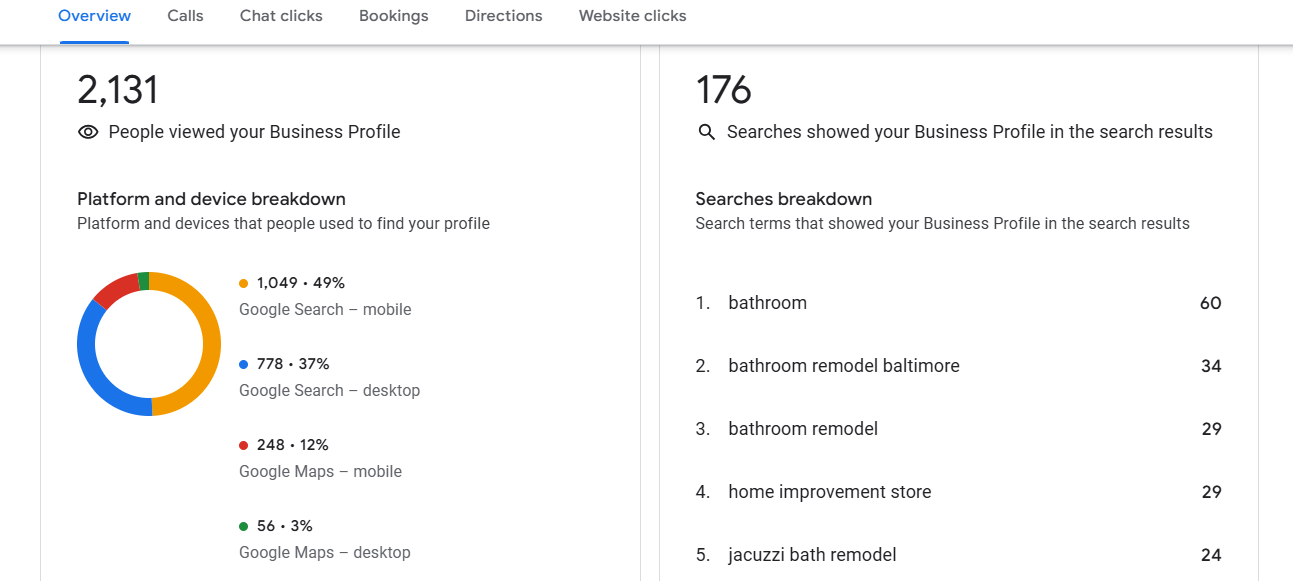
In February, Hector rebuilt their local SEO foundation — replacing outdated tactics, restructuring their service pages around high-intent bathroom remodeling searches, optimizing their Google Business Profile, and installing clear tracking.
Within three months, Bath Doctor was ranking in the top three Map results for their primary bathroom remodeling keywords in Baltimore. Qualified calls increased steadily. Three months later, they eliminated their debt and were booked out four months in advance with consistent projects.
What changed wasn’t a “new trick.”
What changed was control.
They rebuilt visibility where homeowners were actually searching, strengthened local proof, and installed tracking so results were tied to booked work—not vanity metrics—helping them complete projects, protect credit, and win back stability.
A Simple Next Step
If your renovation leads feel inconsistent, it’s not random.
It’s structural.
The fix usually isn’t “one more platform” or “turn the ads up.” It’s building a predictable system you control:
- Visibility in Maps and local search
- Proof that reduces price-shopping
- Tracking that ties marketing to signed contracts
If you want a second set of eyes on your lead flow, we’ll walk through it with you.
No pressure. No pitch deck.
Just clarity on what’s producing real home renovation leads, what’s wasting money, and what would make the next 90 days more predictable—so you can fill the schedule, manage your team, and move ahead with confidence.
More From Us